Pages

Showing posts with label Business. Show all posts

Friday, November 13, 2020

IN FOCUS: After COVID-19, where are the Singapore economy, workforce headed? - CNA

SINGAPORE: Recession. Retrenchments. Reskilling.

As COVID-19 has ripped through the Singapore economy, such words have become part of daily life. 

When the then little-known disease made its way to Singapore in January, few could have anticipated the impact on people and businesses.

Very quickly, people’s normal routines – working in the office, eating out, face-to-face gatherings with loved ones and friends – were changed. Firms had to return to the drawing board to work out contingency plans to stay in business.

The economy swiftly slipped into contraction, setting a grim record for the second quarter even with nearly S$100 billion in stimulus, and is now set for its worst-ever recession.

READ: COVID-19 downturn to be more prolonged than past recessions, slow recovery for jobs market: MAS

With uncertainty about when the COVID-19 crisis will come to an end, coping with hurtling changes has been the only constant.

Economic scarring aside, the pandemic has, among other things, accelerated the adoption of technology - e-commerce, financial technology, video-conferencing, telemedicine or online teaching - as a way of life.

These have hit some people and firms harder than others in the form of collapsed businesses and lost jobs, as their activities depend more on close contact, or because of their age and skills.

“The pandemic accelerated many of the trends, like digitalisation (and) ebbing globalisation, that we’ve already been seeing prior to the outbreak. With the changes compressed into a very short time, this causes challenges at all levels - governments, businesses, individuals – as we all have to adapt in a much more time-constrained fashion,” said Institute of Policy Studies’ (IPS) senior research fellow Christopher Gee.

“Those who are agile enough to transform quickly, will survive.”

For home-grown additive manufacturer 3D Metalforge, demand dropped sharply at the start of the coronavirus outbreak. The 3D metal printing firm supplies critical parts and expertise to manufacture components used in various industries.

Demand has since recovered, according to its chief executive Matthew Waterhouse, and amid the shifts, it found opportunities.

For instance, supply line disruptions have prompted firms to turn to manufacturers closer to home for critical parts. With its 3D printing capabilities, 3D Metalforge has “been able to step in when companies needed things in a very short timeframe”.

Mr Waterhouse said such opportunities could be here to stay.

READ: Companies seek new opportunities to stay afloat amid COVID-19 pandemic

He noted ongoing chatter among companies, especially in the United States and Europe, “about bringing manufacturing nearer to the point of use” as the pandemic crippled global supply lines.

“As companies move their manufacturing back to the US, I think they are going to want to focus on high-value manufacturing, which is where additive manufacturing fits in.”

The attention on digital supply chains has also grown.

“In the old days, they’d create a mold or jig and store it in the workshops. Now they can create a digital file and pass it on to manufacturers like us to produce the part,” said Mr Waterhouse.

“(Creating digital files) was already gathering pace (and) the area that I think has accelerated even further is taking that digital file and storing it in the cloud so that if you need to manufacture in place A or place B or C, you've got it available where you need it.

“It’s the idea of supply chains becoming more virtual, more flexible with the use of a 3D printer and additive manufacturing to produce things wherever you need. We've got a very key role in the end point of these digital supply chains,” he added.

AT A “CRITICAL JUNCTURE”

Just as how companies like 3D Metalforge are in search of a silver lining amid the crisis, the Singapore economy will have to keep transforming.

“The post-COVID-19 global economy will be different. Our future economy must be responsive to structural shifts, many of which have been accelerated by COVID-19,” said Deputy Prime Minister Heng Swee Keat in a ministerial statement on Oct 5.

READ: Commentary: Winds in the Singapore economy sails are starting to stir

Apart from weakening support for globalisation and renewed impetus to adopt digital technology, other structural shifts include the rise in Asia’s economic weight, growing emphasis on sustainability and slower resident labour force growth at home. 

As such, the Singapore economy is “at a critical juncture” with high stakes involved.

Mr Heng told Parliament: “We must take the actions now that will allow us to not just get through COVID-19, but more crucially, gain ground that will pave the way for our next lap of economic growth in the next five to ten years.”

HOW TO TRANSFORM

So, how can the Singapore economy transform for the future?

Observers that CNA spoke to think it is unlikely that the country will veer away from a diversified economic structure.

After all, it is this diversification that has steered the small and open economy through previous crises and even in this downturn, there remain bright spots.

Manufacturing, for one, is among those that have withstood the heavy blows of the pandemic, bolstered by strong semiconductor and biomedical production activities. Other sectors such as finance and insurance, and information and communications, have also remained on steady growth paths.

READ: Some economic bright spots remain for Singapore despite the overall challenging conditions

This shows that diversification has paid off, according to Ms Jung Sung Eun from Oxford Economics, who added: “Given its small domestic economy, Singapore will benefit from keeping its economy diverse and open.”

OCBC’s head of treasury and research Selena Ling echoed that it has always been “part of the Singapore philosophy to grow as many engines of growth as possible” to provide a buffer during different industry cycles.

“But we have to diversify smartly because we are a small country,” she said. “There can only be so many buckets to put your resources into.”

What then can Singapore focus on?

Manufacturing may be one area for further development if the current bright spots are to go by. This as the current engines of growth within the sector - electronics, precision engineering and biomedical clusters - are likely to keep revving, said Ms Ling.

The semiconductor industry will remain supported by rapid growth of cloud usage for remote working and home entertainment like video streaming and gaming, while the biomedical space is set to benefit from high demand for instruments and test kits, as well as critical supplies such as masks and medical equipment, she noted.

A keen focus on technology also means Singapore is well-positioned to strengthen its manufacturing sector, by boosting productivity for lower-end activities and growing higher-value processes, other observers said.

Already, it has a strong base in advanced manufacturing with industries such as precision engineering and biomedical sciences. And the country is doing more.

Mr Heng, at an Industry 4.0 trade show last month, stressed that Singapore is committed to developing cutting-edge capabilities, such as robotics, to become a "more digital and more resilient” advanced manufacturing base in Asia for the world.

READ: Commentary: Manufacturing is still a key engine of growth for many countries

Mr Douglas Foo, president of the Singapore Manufacturing Federation (SMF), said: “Not just advanced manufacturing, (growth will also come from) lean manufacturing and the adoption of new business models to seek out new revenue channels made possible with technology.”

SMF has set a target for the sector to contribute 30 per cent of Singapore’s overall gross domestic product (GDP) by 2030, but said this may only be possible if more industries are included in the sector.

Manufacturing has evolved, explained Mr Foo, citing non-traditional segments such as additive manufacturing bearing much potential to raise the sector’s output. Other industries like agriculture are also applying the latest manufacturing technology to improve production.

“Therefore, it is possible to achieve the 30 by 30 goal, only if the manufacturing sector is less defined,” he said.

DBS senior economist Irvin Seah certainly thinks the sector can form a bigger component of Singapore’s future economy.

Manufacturing accounted for nearly 30 per cent of GDP in the early 2000s but that has since fallen to about one-fifth. There is scope to increase this to at least 25 per cent, he said.

“Manufacturing has always been an instrumental part of Singapore’s growth but over the years, its share of GDP has been falling. Given how it has been the key driver of growth during the pandemic, it raises the question of whether we should raise (the share). I think we should.”

READ: 6,370 job openings in manufacturing, marine and offshore sectors despite downturn

Conversations with observers of the Singapore economy also threw up two overarching themes - technology and sustainability. Both will spawn a myriad of opportunities in multiple industries, they said.

The former will only become more pervasive with essential services such as healthcare seeing a rise in telemedicine services. Even traditionally brick-and-mortar industries such as retail and food services, have gone digital to survive amid the pandemic.

Sustainability will be a “long-term theme that impacts Singapore’s economic structure”, according to Mr Seah. 

“As the world’s focus on sustainability grows, there will be demand for related technology, product and infrastructure,” he said. This ranges from infrastructure to guard against rising sea levels, as well as technologies for electric vehicles, harnessing clean energy and ramping up food security.

The financial space is already grasping this new reality and its implications for investment, said Ms Ling, with the Monetary Authority of Singapore (MAS) playing an active role in positioning the country as an “industry leader” in this aspect.

For instance, the MAS announced a US$2 billion investment last November to develop green markets. The central bank also supported the launch of the country’s first institute dedicated to green finance research and talent development.

READ: Commentary: Forces of climate action are reshaping finance in Singapore and around the world

Ms Jung said as green energy is likely to be a key growth sector moving forward, Singapore can do more to promote research and development in related industries, such as renewable energy, electric vehicle manufacturing and sustainable building.

There can also be incentives to encourage private sector investment in this field, she added.

The Government has certainly set its sight on this area, with Mr Heng highlighting sustainability as part of the country’s refreshed economic strategy. The Ministry of Sustainability and the Environment also said it expects 55,000 “new and upgraded” jobs to be created over the next ten years as the country pursues sustainable development, including about 4,000 in the next year.

On the other hand, the waning of some industries could also change the make-up of the Singapore economy.

The brick-and-mortar retail space, for instance, is in for more pain as the COVID-19 pandemic “only solidified the way forward for online shopping”, said Mr Seah.

STAY NIMBLE AND OPEN

On top of the cherry picking, observers said the crux is for the Singapore economy to remain nimble.

“I think the catchword going forward is adaptability ... Singaporeans and Singapore businesses should have the flexibility to adapt to rapidly changing circumstances,”said Mr Gee.

The country also needs to leverage on its strengths as a business hub, he added.

View of Singapore skyline, amid the coronavirus disease (COVID-19) outbreak
A view of Singapore skyline, amid the coronavirus disease (COVID-19) outbreak, in Singapore on Jul 14, 2020. (Photo: Reuters/Edgar Su) 

“We should recognise that we are and have already established ourselves as a hub for many necessary and integral things for the global economy. We can continue to be a stable, secure and trusted hub, with seamless connections.”

However, there is competition.

Mr Thomas Willemsen, senior vice-president of Asia Pacific at Japanese pharmaceutical giant Takeda, pointed out that some pharmaceutical firms have decided to locate their headquarters for Asia or emerging markets in Shanghai.

He said there are many benefits to locating in Singapore: "The environment, education, security and lifestyle are already top of the charts so I don't think you can necessarily make it so much better but I think you should also not try to scale back on these.

“More limitations on, let's say, foreign experts (coming) to Singapore will be not good because at some point, Singapore is also competing. Singapore cannot be the hub choice forever.”

Mr Seah also stressed the need for the country to deepen its linkages within Southeast Asia.

The rise of its closest neighbours means that Singapore “may no longer be the favoured destination”. “In order to leverage on the regional growth, we have to be out there and invest more heavily in ASEAN so that we can benefit directly,” he added.

WHAT ABOUT JOBS?

Domestically, the workforce will also have to keep up in step with the transformation.

Already, the economic fallout has caused a double whammy to workers. One is the greater risk of losing their jobs as companies cut back on capacity and restructure.

WATCH: Badly hit by COVID-19, when will Singapore's jobs market recover? An explainer

For a start, Singapore’s jobless rate had shot up to a 16-year high, at 3.6 per cent, in September, while retrenchments - at 20,450 so far - were nearly double those for the whole of 2019. Economists have warned that while the labour market will bottom out by the end of this year, it will remain subdued until the middle of next year.

Recruitment, while having recovered somewhat since the second quarter, has stayed muted. Business networking site LinkedIn found that the hiring rate - calculated by the number of hires divided by the number of LinkedIn members in Singapore - was only 5 per cent more in September compared to the same period in 2019. In February, the rate was nearly 50 per cent.

On job portal Indeed Singapore, while postings had gone back up after a decline in the middle of the year, in October it was still six per cent less than the total in the same period last year.

“While the economy is gradually reopening, many businesses are still unable to operate at full capacity due to safe distancing restrictions,” explained LinkedIn’s Asia-Pacific vice-president of talent and learning solutions Feon Ang.

LinkedIn also found that in September, job seekers in industries that were severely impacted by the virus - particularly construction and recreation & travel - were much more likely to apply to jobs outside of their current industry compared to pre-COVID-19 days.

Linkedin data

Secondly, many jobs that were lost may never come back. In a report he published back in June, Mr Seah said the pandemic has hastened the pace of restructuring the Singapore economy from its decade-long journey to just a couple of months.

More recently, in the latest World Economic Forum Future of Jobs 2020 report that surveyed 29 companies with operations in Singapore among nearly 300 worldwide, firms in Singapore indicated that roles ranging from bank tellers and accountants, to data entry clerks and factory workers were increasingly redundant in their organisation.

WEF data singapore
Firms with operations in Singapore indicating what kinds of employees they need most and least in the latest World Economic Forum Future of Jobs report published in October. 

Meanwhile, people with deep technological skills - data analysts, digital marketers and Internet of Things Specialists - are in high demand.

Similarly, Indeed Singapore found that hiring activity of traditional professional services employees - those in sales, administrative, human resource and accounting - fell the most in the third quarter year-on-year, while demand for medical, logistics, scientific and technology roles grew, its Asia-Pacific economist Callum Pickering said. 

indeed data

“The outbreak of COVID-19 has accelerated the digital transformation of companies and changed the way we work almost overnight as organisations adapt their operations to comply with the safety requirements,” said recruitment agency ManpowerGroup’s country manager Linda Teo.

To help workers cope with the rapid changes, the Ministry of Manpower has put out weekly Jobs Situation Reports since August, where it outlines the number of available job and training openings in various sectors including retail, manufacturing, and logistics. For instance, the latest release signaled there were 6,370 manufacturing job openings as of mid-October.

READ: As COVID-19 speeds up automation, what does the future hold for non-tech job seekers?

However, the deeper issue lies in a skills gap. Referring to an internal survey conducted with about 539 SMF members, Mr Foo said that though three quarters of them pointed out they are still hiring because they need individuals with specific skills in areas like software engineering, robotics and precision grinding, such talent is mainly available overseas.

And while almost nine out of 10 of these members are willing to reskill their workforce, most of the necessary training courses are only available overseas - making them nearly impossible to attend with travel restrictions in place, Mr Foo said.

Authorities have tried to fill the sudden void that emerged during this period. According to SkillsFuture Singapore, 12,950 training opportunities under the SGUnited Skills programme opened up in July and August. Over 13,000 people signed up for them in the same period.

But training will take time. In a previous interview with CNA, HL Bank’s Jeff Ng said that job seekers may not be able to keep up with how fast the restructuring is occurring right now.

READ: COVID-19: Switching careers a challenge for some job seekers despite opportunities

“I think during normal times, there could be a slow transition from the lower value-added economy to a more higher value-added one, and definitely there's a lot of time for workers to slowly train and adapt to these changing conditions,” the bank’s senior treasury strategist said.

“But at this current moment where the pace of change (is) least five to 10 times more … one challenge workers face is the rapid retraining in order to adapt with these fast-changing times.”

LinkedIn’s Ms Ang agreed, adding that many job seekers may not know where to begin finding new roles that are relevant to their current skills or how to pick up new ones so that they can switch industries.

Takeda’s 500-odd workforce in Singapore currently has a fair amount of foreigners here to provide the necessary skills and experience, Mr Willemsen said. While Singaporeans have educational and language advantages, they need to also be willing to work outside of the country and have a “genuine curiosity … to explore other cultures and other markets”.

He said headcount here would see a “moderate increase overtime” as it prepares to launch its dengue fever vaccine in 2022 and develop its research and development activities. Its ongoing series of divestments has minimal impact on the office here, he assured.

READ: Five tips for job seekers - from learning new skills to taking a contract position

Mr Waterhouse said it is a mixed bag in his company. While there are roles in his company that require an engineering background, they have also welcomed mid-career switchers from the likes of the oil and gas industry, and others with no experience in additive manufacturing.

“You’d start doing the more practical work of handling the powders (raw materials in powder form), handling the machines … then learning about the machines, then maybe moving into the design side,” he said.

The upside of the pandemic is that it has become easier to hire, Mr Waterhouse said. There is now a pool of older, “very capable” workers looking for jobs. And fresh graduates, who are usually gunning for positions in multinational corporations, have become more open about joining a small business like his.

READ: Challenging job-hunting landscape as recruitment agencies see fewer vacancies and more applications

One of them is Mohd Nasir Ja’apar, who joined 3D Metalforge in July after losing his job as a quality engineer in the oil and gas field four months earlier. He is now in a similar role in his new firm - something the 15-year oil and gas veteran never imagined.

“The term (additive manufacturing) is so alien to me,” the 47-year-old said. When a career coach first suggested interviewing with the firm, he thought it was about toy-making, not manufacturing industrial parts out of digital files.

But after working with robotic arms and observing how the metal components are being printed over the past three months, he is genuinely excited about where he is right now - even the 20 per cent pay cut does not bother him.

“It’s the next big thing,” he said. “I’m excited by the possibilities of the technology and the huge growth potential this industry has.”

BOOKMARK THIS: Our comprehensive coverage of the coronavirus outbreak and its developments

Download our app or subscribe to our Telegram channel for the latest updates on the coronavirus outbreak: https://cna.asia/telegram

Let's block ads! (Why?)

Article From & Read More ( IN FOCUS: After COVID-19, where are the Singapore economy, workforce headed? - CNA )
https://ift.tt/32IYeKM
Business

Thursday, November 12, 2020

Fresh vaccine hope as world tops 10000 daily COVID-19 deaths - CNA

LONDON: Top US government scientist Anthony Fauci said on Thursday (Nov 12) the coronavirus vaccine "cavalry" was on its way, bringing fresh hope as the world registered more than 10,000 deaths in just 24 hours, a record.

The world-leading expert on infectious diseases said that after this week's much-trumpeted news that a vaccine developed by US drug giant Pfizer and Germany's BioNTech was 90 per cent effective, another is "literally on the threshold of being announced."

"The cavalry is coming, but don't put your weapons down," Fauci said by video-link to a think-tank in London, as US biotech firm Moderna was poised to reach a threshold in vaccine trials that would allow it to apply for an emergency use authorisation from US regulators.

The scientist, who has gained global fame for standing up to President Donald Trump on COVID-19, urged the public to continue respecting public health measures such as wearing masks and washing hands.

Palestinian men walk past street art showing doctors mask-clad due to the coronavirus pandemic, in
Palestinian men walk past street art showing doctors mask-clad due to the coronavirus pandemic, in Khan Yunis in the southern Gaza Strip. (Photo: AFP/Mohammed Abed)

News of promising vaccine results has brought much-needed hope as the world grapples with a pandemic that shows no sign of abating, with grim statistics flowing in day after day.

An AFP tally of official sources found Thursday that the daily number of global deaths had gone over the symbolic level of 10,000 in the past 24 hours for the first time since the start of the pandemic, standing at 10,010.

''PEOPLE JUST DON'T CARE'

Global markets slid on fears of the virus surge that threatens economic recovery, eroding earlier gains led by vaccine hopes.

France reported Thursday that the number of people in hospital for COVID-19 was now higher than previous peaks in April.

Serbia's Health Minister Zlatibor Loncar meanwhile cautioned that there were no more hospital beds available for virus patients in the capital Belgrade.

But for all the dire warnings, there was growing evidence that people were ignoring restrictions imposed by governments and minimising the risk of infection.

In France, a survey revealed that more than half of the population had broken regulations governing a current partial lockdown.

Medical workers arrive at a hospital in Naples in an ambulance with a COVID-19 patient
Medical workers arrive at a hospital in Naples in an ambulance with a COVID-19 patient. (PhotoL AFP/Filippo Monteforte)

It showed that 60 per cent had flouted the rules at least once, either by giving a false reason for going out on their self-signed permission slip or by meeting up with family and friends.

"The second wave is extremely strong," Prime Minister Jean Castex warned in a virtual news conference. "One in four deaths is now due to COVID."

READ: French PM says easing COVID-19 lockdown now would be 'irresponsible'

Over in India, crowds packed New Delhi markets ahead of the Diwali festival of lights, the country's biggest holiday, saying they were fed up with being cooped up.

India has the world's second-highest caseload behind the United States, and there are fears that a Diwali surge could hit major cities across the country of 1.3 billion.

"People just don't care," said Tanisha, a 19-year-old student. "People want to come out."

"I am so bored at home that I am not scared to shop."

VACCINE CONCERNS

Compounding the weariness, a report by a non-profit that fights misinformation delivered worrying news on Thursday, saying conspiracy theories about COVID-19 vaccines played an "outsized role" on social media that could threaten their efficacy.

A resident at the Domenico Sartor nursing home near Venice hugs her visiting daughter
A resident at the Domenico Sartor nursing home near Venice hugs her visiting daughter through a plastic screen in a so-called "Hug Room". (Photo: AFP/Piero Cruciatti)

Many posts analysed by researchers at First Draft linked vaccines to conspiracy theories such as the belief that a future COVID-19 shot will be used to microchip individuals and develop mass population-tracking systems.

Some posts claimed vaccines that used the novel mRNA technology - as developed by Pfizer, BioNTech and Moderna - would "change people's DNA," or linked them to "targeted depopulation efforts or malign human engineering programs".

"We have reached a pivotal and hypersensitive crossroads where increasing rates of vaccine scepticism may not only jeopardise the effectiveness of a potential COVID-19 vaccine, but that of vaccines more broadly," the non-profit said.

There were also concerns about poorer countries' access to future vaccines.

With that in mind, the Paris Peace Forum international conference was set to raise more than US$500 million for a mechanism led by the World Health Organization that aims to ensure access to coronavirus tests, treatments and vaccines for all countries.

And there was some good news in Britain, whose economy enjoyed a record third-quarter rebound from its deepest ever recession, even if experts predicted another slump due to fresh virus restrictions.

BOOKMARK THIS: Our comprehensive coverage of the coronavirus outbreak and its developments

Download our app or subscribe to our Telegram channel for the latest updates on the coronavirus outbreak: https://cna.asia/telegram​​​​​​

Let's block ads! (Why?)

Article From & Read More ( Fresh vaccine hope as world tops 10000 daily COVID-19 deaths - CNA )
https://ift.tt/32HbmjL
Business

Singapore Airlines raises S$850 million through convertible bond issue - CNA

SINGAPORE: Singapore Airlines (SIA) has raised S$850 million through a convertible bond issue, announced the national airline on Friday (Nov 13). 

The offer was more than four times oversubscribed "with strong investor interest", said SIA in the media release. 

READ: SIA share price soars as much as 21% as markets cheer COVID-19 vaccine news

READ: Singapore Airlines confident of having 'very strong liquidity' as it explores new sources of funds to tide through COVID-19: CEO

"As a result, the issuance was upsized from the initial S$750 million to S$850 million with more attractive terms for SIA," it added. 

The five-year bonds, which have been placed with a variety of institutional investors, will carry a coupon of 1.625 per cent. They can also be converted into ordinary shares at a price of S$5.743. 

This represents a 45.8 per cent increase from Thursday's closing price of S$3.94.

"This issuance further strengthens the company’s liquidity position, and bolsters its ability to navigate the challenges posed by the impact of the COVID-19 pandemic on the business," said SIA. 

It added that proceeds from the bonds will be used to fund operating and capital expenditure, and debt servicing. 

HSBC bank is the sole bookrunner and lead manager of the issue. 

The airlines said that "positive discussions" have taken place on aircraft sale-and-leaseback transactions, and that it will continue to explore other means to "strengthen ... liquidity as necessary".  

SIA has raised approximately S$12.2 billion since the start of the 2020/2021 financial year, including Friday's issuance. 

The airlines said that for the period up to July next year, it retains the option to raise up to S$6.2 billion in additional mandatory convertible bonds that would provide further liquidity if necessary. 

Earlier this week, SIA said it managed to reduce its monthly cash burn to “below S$300 million”, down from about S$350 million a month in the three months of May to July. 

READ: SIA Group reports first half net loss of S$3.5 billion as passenger numbers fall by 98.9% amid COVID-19

In the release, CEO Goh Choon Phong said the placement was "successfully executed with a highly competitive coupon and substantial conversion premium". 

"Such attractive terms for the company underscore the strong confidence that investors have in Singapore Airlines, as well as our ability to successfully overcome the near-term challenges and emerge as a leader in the airline industry,” added Mr Goh. 

On Tuesday, SIA's share price rose as much as 21 per cent during intraday trading to a five-month high, as markets rallied on news that a vaccine candidate was 90 per cent effective in treating COVID-19 patients. 

Let's block ads! (Why?)

Article From & Read More ( Singapore Airlines raises S$850 million through convertible bond issue - CNA )
https://ift.tt/2UmwMOn
Business

Chinese President Xi Jinping decided to halt Ant's IPO, reports Wall Street Journal - The Straits Times

NEW YORK (REUTERS) - China's President Xi Jinping personally decided to pull the plug on Ant Group's US$37 billion (S$50 billion) initial public offering, the Wall Street Journal reported on Thursday (Nov 12), citing Chinese officials with the knowledge of the matter.

The decision to stop what would have been the world's largest ever IPO, came days after the fintech giant's billionaire founder Jack Ma launched a public attack on the country's financial watchdogs and banks.

President Xi ordered Chinese regulators to investigate and effectively shut down Ant's stock market flotation, the report said.

Ant Group did not immediately respond to Reuters request for comment.

The Information Office of the State Council, China's Cabinet, could not be reached immediately for comment.

Mr Ma had told a summit in Shanghai on Oct 24 that the regulatory system was stifling innovation and must be reformed to fuel growth.

Earlier this month, Reuters reported the speech set off a chain of events that torpedoed the listing of Ant.

Soon after Mr Ma's scathing speech, state regulators started compiling reports including one on how Ant had used digital financial products like Huabei, a virtual credit card service, to encourage poor and young people to build up debt.

The general office of the State Council compiled a report on public sentiment about Mr Ma's speech and submitted it to senior leaders including President Xi, Reuters had reported.

Let's block ads! (Why?)

Article From & Read More ( Chinese President Xi Jinping decided to halt Ant's IPO, reports Wall Street Journal - The Straits Times )
https://ift.tt/3neYN6Q
Business

Wednesday, November 11, 2020

Commentary: Pfizer reaches COVID-19 vaccine breakthrough – a step closer to pandemic's end - CNA

CORK, Ireland: Preliminary data from the Pfizer/BioNTech COVID-19 vaccine trial suggests it provides 90 per cent efficacy at preventing the disease.

At the very least, this news will result in a large sigh of relief across the vaccine community. It signifies a breakthrough – it’s the first announcement that a vaccine can protect against SARS-CoV-2 infection in humans.

This shows it can be done. But how well it can be done is still a big question that no one has the answer to. These results are promising, but there’s a lot more we now need to confirm.

READ: Commentary: Why rushing a COVID-19 vaccine could spell disaster

FAST-TRACKING THE INTERIM ANALYSIS

The 90 per cent efficacy is a strong result, but we should remember that this is an interim analysis, based on 94 cases of disease that have occurred across those receiving either the vaccine or a placebo.

Pfizer has noted in its trial protocol that it needs at least 164 cases of disease to occur across the study to reliably assess the vaccine’s efficacy.

If subsequent cases occur more frequently among those who have had the vaccine rather than the placebo, then this efficacy figure will fall. So we don’t yet know if this number is truly reflective of the vaccine’s protective ability – meaning crucially, we need to get to the end of the trial.

But if this is the case, why announce these interim results now?

LISTEN: The COVID-19 vaccine will be the biggest product launch in history. Can we pull it off?

An interim analysis of trial data like this isn’t uncommon, particularly in phase 3 vaccine trials, as it’s not unusual for trials to fail during testing.

Therefore, you need to determine as soon as you can, with as much robustness as you can, whether pursuing the trial is worthwhile. Continuing when things are futile is a waste of resources – and in some cases unethical.

The only way to see whether continuing is the right option is for the trial’s independent data and safety monitoring board to look at some or all of the results.

A nurse shows a Covid-19 vaccine produced by Chinese company Sinovac Biotech at the Sao Lucas
A nurse shows a Covid-19 vaccine produced by Chinese company Sinovac Biotech at the Sao Lucas Hospital, in Porto Alegre, Brazil AFP/SILVIO AVILA

For COVID-19, where time is a major constraint, many efforts have been made to incorporate interim analysis into studies in a way that provides an answer, with some confidence, in as timely a manner as possible.

This interim review was therefore planned at the start of the trial, and has fulfilled its purpose. It is a very positive signal that the trial needs to continue – even if the actual data from the review leaves us with many questions.

READ: Explainer: Where are we in the COVID-19 vaccine race?

READ: Commentary: COVID-19 vaccine – why is it taking so long to develop one?

REVIEWING EFFICACY AND IMMUNE RESPONSE THE NEXT STEPS

One key thing these interim results don’t tell us is how long protection lasts. Participants in this phase 3 trial received two doses of the vaccine, and measurement of its efficacy was taken seven days after the second dose was given.

This is likely around the height of the initial immune response. It will be really important to understand how durable this initial protection is after this point.

A pessimist would hope for retaining efficacy for at least three months. An optimist would hope for retaining high levels of protection for a number of years.

READ: Commentary: Could Indonesia be Southeast Asian hub for Chinese COVID-19 vaccine?

However, being realistic, this mRNA-based vaccine platform is new, and so we’ll need time to understand if and when the initial response starts to wane. We also need to understand if this vaccine and others in development can induce good memory responses from the immune system that will provide protection for years to come.

It’s also important to identify the exact immune response that is mediating protection – what are called the “correlates of protection”. Is it a particular type of antibody or T cell that’s involved, and what is the threshold amount of these needed to protect an individual?

With this knowledge, future trials can focus on measuring the quantity of these immune markers in individuals to better assess whether vaccines are working.

FILE PHOTO: People wear face masks amid the global outbreak of the coronavirus disease (COVID-19)
FILE PHOTO: People wear face masks amid the global outbreak of the coronavirus disease (COVID-19) at Shanghai Railway Station in Shanghai, China, November 10, 2020. REUTERS/Aly Song/File Photo

One other important thing we need to know is whether the vaccine completely prevents people from getting infected with any virus at all, or if it simply makes people more effective at fighting the virus off if they do succumb to some infection.

This will govern whether the vaccine prevents only disease or can prevent viral transmission as well. All we know at the moment is that it has reduced symptomatic cases by 90 per cent.

READ: Commentary: Who will get the COVID-19 vaccine Chinese companies are developing?

THE ROAD TO APPROVAL AND BEYOND

Though it doesn’t have the full picture, the US FDA has said it will consider authorising the vaccine for emergency use – ahead of full approval – once the trial has collected two months’ worth of safety data on half of the participants. Pfizer expects to have this available by the third week of November.

The trial will also continue for many months to come – in order to reach that reliability threshold of 164 cases of disease – and there will be further follow-ups looking at the vaccine’s safety and the immune responses and protection it elicits in different groups of participants.

This should give further transparent information and confidence on how well this vaccine works and in which populations.

READ: Commentary: The challenge of keeping COVID-19 vaccines at sub-zero temperatures during distribution

If the vaccine’s safety and efficacy are looking good, it will then be submitted to regulatory agencies for full approval. The highest risk groups will then be first in line for immunisation.

In the UK, this will likely include care home residents and workers, health and social care workers, and people over 80, assuming the vaccine is shown to be safe and effective in these groups.

In Europe, prioritised groups include healthcare and essential workers, those vulnerable to the disease and socioeconomically disadvantaged people.

The spread of the coronavirus disease (COVID-19) in Rome
A nurse leans from a balcony, as the spread of the coronavirus disease (COVID-19) continues, in Rome, Italy, May 2, 2020. REUTERS/Remo Casilli

But even if approved, big challenges remain. Pfizer expects to have 50 million doses ready this year, enough to immunise 25 million people, and 1.3 billion by the end of 2021.

Given the size of the world’s population – and the fact the vaccine requires two doses – universal coverage is a long way away.

The other vaccines in development therefore remain just as important. We will need more than one vaccine for global coverage, and to ensure we have the right one for each age and health cohort.

Overall, these results should be celebrated, but with the realisation that this is only one step in the journey. We still have a long way to go in getting the world back to normal – but the compass is pointing in the right direction.

BOOKMARK THIS: Our comprehensive coverage of the coronavirus outbreak and its developments

Download our app or subscribe to our Telegram channel for the latest updates on the coronavirus outbreak: https://cna.asia/telegram

Anne Moore is Senior Lecturer in Biochemistry and Cell Biology at University College Cork. This commentary first appeared on The Conversation.

Let's block ads! (Why?)

Article From & Read More ( Commentary: Pfizer reaches COVID-19 vaccine breakthrough – a step closer to pandemic's end - CNA )
https://ift.tt/38BqDq6
Business

Singapore-Hong Kong air travel bubble possibly world first: Ong Ye Kung - Yahoo News Singapore

SINGAPORE, Nov. 1, 2020 -- A Singapore Airlines A380 aircraft is seen at Singapore's Changi Airport Terminal 3 on Oct. 31, 2020. Over two weekends from Oct. 24 to Nov. 1, Singapore Airlines hosted diners in two A380 passenger aircraft docked in Changi Airport Terminal 3, offering customers a chance to have meals in an aircraft setting. (Photo by Then Chih Wey/Xinhua via Getty) (Xinhua/Then Chih Wey via Getty Images)

SINGAPORE – The Singapore-Hong Kong air travel bubble (ATB) is the first of its kind in the region – perhaps the world – and that is significant, said Transport Minister Ong Ye Kung on Wednesday (11 November).

In a virtual media conference, he said, “It is an air travel bubble between two regional aviation hubs who decide to open up to each other, and that is significant. There is no restriction on what kind of travellers so it’s quite unlike the RGL (Reciprocal Green Lane), which is restricted to business travellers. This covers all travellers: couples uniting, partners uniting, visiting families, tourism, so on and so forth.”

Under the ATB, which will start on 22 November, travellers between Singapore and Hong Kong will be subject to COVID-19 tests, in lieu of quarantine or Stay-Home Notice. There will be no restrictions on the purpose of travel and no requirement for a controlled itinerary or sponsorship, but travellers must bear the cost of the Polymerase Chain Reaction (PCR) tests.

It will begin with one flight a day into each city, with 200 passengers each way. Singapore Airlines and Cathay Pacific Airlines, the respective flagship carriers for each city, will take turns to run flights on alternate days.

Ong stressed that the ATB is not only the first step to rebuild the respective aviation hubs, but “in the case of Singapore, (it) is not just about the aviation sector or tourism sector, it is about making sure there is a future for Changi, there is a future for SIA”.

Asked why the two sides had chosen to go straight into the ATB rather than begin with an RGL, Ong said it was down to the two cities’ familiarity with each other as aviation hubs, and a recognition that the respective airports and airlines are “critical to our survival”. The Republic was also responding to the territory’s invitation to various countries to establish an ATB

“And so from day one, I think we don't beat around the bush, to say that let's go for air travel bubble, rather than take it step by step. So it's really a meeting of the minds.”

Ong added that if successful, the ATB will be a good reference point for others.

“If we can demonstrate to the world that this is successful, it becomes a good reference point, a template and a model that other places, other territories and countries can look at as a point of reference. There are quite a number of places where they have very successfully controlled the virus and epidemic, just like Hong Kong and Singapore have, and they are considering how to open their borders and I hope this could be a template and a reference point for them.”

A six-hour wait in Hong Kong?

Under the ATB arrangements, travellers from Singapore to the territory must be tested for the coronavirus within 72 hours of their departure, then take another test upon arrival at Hong Kong International Airport (HKIA). They are also required to wait at HKIA for their test results.

When asked how long the process would take, Civil Aviation Authority of Singapore (CAAS) director-general Kevin Shum said it would likely take “less than six hours”. Ong expressed hopes that it would take four hours, and that drinks and amenities would be provided.

Acknowledging the “inconvenience and discomfort” of the process, the Minister nevertheless said, “This is as close as it gets to pre-COVID travel, in the sense that wherever you are now, on the Hong Kong side or Singapore side, you don't need anyone to sponsor, to tell you you can travel, or you need a special reason, then you can travel. Now the empowerment is turned around again...you can travel if you want to.”

Ong admitted that he was unsure about travellers’ response to the scheme, and reckoned that they would take a wait-and-see approach first. “I want to see whether I can send off the first batch of Singaporeans on the 22nd of November. It may be a half empty or an empty plane, or a full plane,” said Ong, adding that he hopes the airlines will be “responsible” in their pricing, given the pent up demand for travel.

Suspension of ATB?

There are also provisions in place if there is a resurgence of COVID-19 cases on either side. If the average number of daily unlinked cases over a seven-day period rises to more than five in either Singapore or Hong Kong, the ATB will be suspended for two weeks. The ATB will resume if the number falls back below five on the last day of the suspension period.

Asked what would happen to those who have already booked flights and tests if the ATB is indeed suspended, Ong’s response was bullish. “We didn't set up the ATB or the ATP system with the expectation that we will suspend it someday. We are working really hard to make sure we don't have to suspend it, but this is just in case there are clusters again.”

Nevertheless, there will be procedures for travellers to defer their plans until the ATB restarts, said Ong.

The 50-year-old said that in the early days of the pandemic, the priority was eradicating the virus from the community, and this necessitated the closing of borders. “But now if that is still our problem statement, that is itself a problem, because it means there's a high chance that at the end of all this, we have no Changi Airport and we have no SIA.”

He added, “It's not about the economy, it's about our life...So our choice now is, can we accept some controlled risk that we can mitigate to a very small extent. And we take some of those risks, but give us ourselves the best chance…to continue to maintain our way of life.”

Stay in the know on-the-go: Join Yahoo Singapore's Telegram channel at http://t.me/YahooSingapore

Related stories:

COVID-19 test to be required for some travellers 3 days prior to entering Singapore: MOH

Individuals can test for COVID-19 at approved providers from next month: MOH

Singapore may get COVID-19 vaccine in 1Q 2021, EDB providing almost $300m support

COVID-19: Singapore confirms nine new cases, one in the community

Let's block ads! (Why?)

Article From & Read More ( Singapore-Hong Kong air travel bubble possibly world first: Ong Ye Kung - Yahoo News Singapore )
https://ift.tt/32EoPc6
Business

Tuesday, November 10, 2020

Nearly US$2 trillion traded on COVID-19 vaccine news - CNA

LONDON: News of a breakthrough in the race to find a COVID-19 vaccine sparked one of the heaviest trading days since the height of the pandemic crisis, according to early data analysed by Reuters, with nearly US$2 trillion changing hands on Monday.

Traders stampeded to the riskier plays in equities, foreign exchange and bond markets after Pfizer Inc released positive data on its vaccine trial, while rotating out of safe havens such as technology stocks, Japanese yen and top-rated bonds.

"Volumes (are) also surging as programmes and baskets go to work to either correct portfolio balances or address margin calls," said Mark Taylor, sales trader at Mirabaud Securities, highlighting a jump in volumes in the airlines and banking sectors.

In the United States, nearly US$500 billion worth of trades went through stock markets on Monday, one of the busiest days since March, when coronavirus lockdown fears rattled financial markets. Europe saw US$120 billion traded, according to Refinitiv data.

Value stocks, typically companies that are more sensitive to economic cycles, notched their best one-day performance against their growth-focused peers ever in the United States after Monday's news of an effective vaccine against the coronavirus.

A similar trend was noticed in the bond and currency markets where volumes matched the panic trading seen during the depths of the market mayhem in March and double that of April when the coronavirus pandemic slammed into markets.

Total turnover for the 33 currency pairs on CLS, a major settler of trades in the currency markets, totalled US$627 billion on Monday. Average daily turnover was US$707 billion in March and US$380 billion in April.

Bond market turnover also jumped. Nearly 170,000 contracts changed hands on the popular front-month German bund futures contracts , 1.5 times this year's average, according to Refinitiv data.

Total turnover on German government bonds on Monday totalled nearly 9 billion euros (US$10.63 billion), more than the average since the start of October, according to data from Marketaxess, a major trading platform.

"Turnover was about three times the 30-day average daily volumes in cash and very active in the futures space," said Jimmy Conway, head of EMEA equity trading strategy at Citibank.

Graphic: equity turnover - https://ift.tt/2UhdLgu cent20turnover.png

Graphic: German bond futures - https://ift.tt/2UgnbZq cent20bondper cent20futures.JPG

(Reporting by Thyagaraju Adinarayan and Saikat Chatterjee; Additional reporting by Yoruk Bahceli; Editing by Jonathan Oatis, William Maclean)

Let's block ads! (Why?)

Article From & Read More ( Nearly US$2 trillion traded on COVID-19 vaccine news - CNA )
https://ift.tt/3lkEswB
Business

Shell Singapore to cut 500 jobs over three years amid Pulau Bukom reorganisation - Business Times

Tue, Nov 10, 2020 - 5:39 PM

UPDATED Tue, Nov 10, 2020 - 11:55 PM

SHELL Companies, the local subsidiary of Royal Dutch Shell, is set to cut 500 jobs from its local workforce over the next three years as the group makes changes to its largest refinery, on Pulau Bukom. This amounts to some 38 per cent of the refinery’s current staff size.(see amendment note)

A Shell spokesperson told The Business Times that the company will go from 1,300 staff to approximately 1,100 by the end of 2021, and down further to some 800 employees by the end of 2023.

The earliest staff movement related to the reorganisation will take place in the fourth quarter of 2021, added the spokesperson.

In a statement on Tuesday, Shell said Pulau Bukom will pivot from a crude-oil, fuels-based product slate towards new, low-carbon value chains. This is the company's latest step towards its overarching ambition to be a net-zero emissions energy business by 2050.

It said: "The changes that will have to take place in our businesses will have a corresponding effect on our staff numbers. As Bukom transforms and becomes smaller and smarter, the resizing of operations will result in fewer jobs, but more highly skilled jobs as digitalisation and automation progress."

The company said this move would halve its crude processing capacity, and could deliver a "significant reduction" in carbon dioxide emissions.

Some "significant changes" in Pulau Bukom's refinery configuration will require "increased investments", such as a site-wide digitalisation programme, as well as a study of products that are resilient to energy transition such as biofuels. Shell is also looking at different future feedstocks that are based on greater circularity and renewable raw materials.

"Today, our extensive presence in Singapore's energy sector carries with it a carbon footprint. Our businesses in Singapore must evolve and transform, and we must act now if we are to achieve our ambition to thrive through the energy transition," said chairman of Shell Companies in Singapore Aw Kah Peng.

This round of job cuts at Pulau Bukom closely follows parent company Royal Dutch Shell's announcement in September that it would cut as many as 9,000 jobs amid a company-wide restructuring into low-carbon energy operations.

In August, the oil major announced that the Pulau Bukom site will pilot its virtual-manufacturing technology. Named Digital Twin, the new technology is set to be completed in 2024. Shell said then that it was grooming a pool of technical talent to support this digital transformation.

READ MORE: Singapore refineries starting to cut output amid pandemic pains

Amendment note: An earlier version of this article said that 500 jobs was about 38 per cent of the company's local workforce. The company has clarified that this figure is only for its refinery on Pulau Bukom

Let's block ads! (Why?)

Article From & Read More ( Shell Singapore to cut 500 jobs over three years amid Pulau Bukom reorganisation - Business Times )
https://ift.tt/3kjkktn
Business

Jack Ma’s Botched Ant IPO Becomes a Boost for State Banks - Bloomberg

[unable to retrieve full-text content]

  1. Jack Ma’s Botched Ant IPO Becomes a Boost for State Banks  Bloomberg
  2. Jack Ma's botched Ant IPO becomes a boost for China's state-run banks  The Straits Times
  3. Billionaire Jack Ma Pays High Price for Challenging Regulators  Caixin Global
  4. Delay to Ant IPO shows Beijing’s desire to get the rules right  South China Morning Post
  5. Ant posed threat to China’s centralised control  Financial Times
  6. View Full coverage on Google News
Article From & Read More ( Jack Ma’s Botched Ant IPO Becomes a Boost for State Banks - Bloomberg )
https://ift.tt/2UczRR2
Business

Monday, November 9, 2020

Pfizer vaccine trial success signals breakthrough in pandemic battle - Yahoo Singapore News

View photos
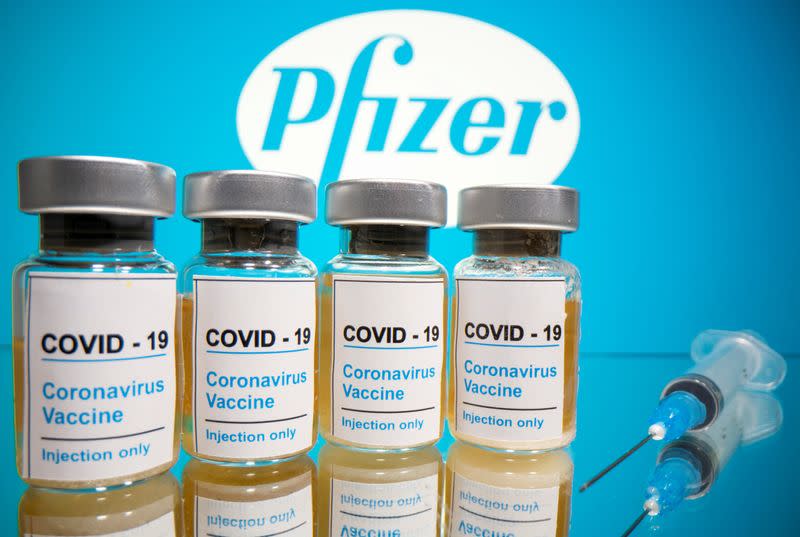
FILE PHOTO: Vials and medical syringe are seen in front of Pfizer logo in this illustration

By Michael Erman and Julie Steenhuysen

(Reuters) - Pfizer Inc's <PFE.N> experimental COVID-19 vaccine is more than 90% effective based on initial trial results, the drugmaker said on Monday, a major victory in the war against a virus that has killed over a million people and battered the world's economy.

Scientists, public health officials and investors welcomed the first successful interim data from a large-scale clinical test as a watershed moment that could help turn the tide of the pandemic if the full trial results pan out. However, mass roll-outs, which needs regulatory approval, will not happen this year and several vaccines are seen as necessary to meet massive global needs.

Pfizer and German partner BioNTech SE <22UAy.F> said they had found no serious safety concerns yet and expected to seek U.S. emergency use authorization (EUA) this month, raising the chance of a regulatory decision as soon as December.

If granted, the companies estimate they can roll out up to 50 million doses this year, enough to protect 25 million people, and then produce up to 1.3 billion doses in 2021.

"Today is a great day for science and humanity," said Pfizer Chief Executive Albert Bourla, noting the data milestone comes with "infection rates setting new records, hospitals nearing over-capacity and economies struggling to reopen."

Experts said they wanted to see the full trial data, but the preliminary results looked encouraging.

"This news made me smile from ear to ear. It is a relief to see such positive results on this vaccine and bodes well for COVID-19 vaccines in general," said Peter Horby, professor of emerging infectious diseases at the University of Oxford.

There are still many questions, such as how effective the vaccine is by ethnicity or age, and how long it will provide immunity, with social distancing and face covering set to remain for the foreseeable future.

Pfizer expects to seek U.S. emergency use authorization for people aged 16 to 85. To do so, it will need two months of follow-up safety data to assure no side effects crop up. That is expected to be available in the third week of November.

U.S. Health and Human Services Secretary Alex Azar said it would take several weeks for U.S. regulators to receive and process the data before a potential approval.

MARKETS SURGE

The prospect of a vaccine electrified world markets with the S&P 500 and Dow hitting record highs as shares of theme park and travel companies battered by the pandemic soared. Movie chain operator AMC Entertainment Holdings was up 60%.

Shares in companies that have thrived during lockdowns, such as Netflix Inc <NFLX.O> and conferencing platform Zoom Video <ZM.O> tumbled.

Pfizer shares jumped more than 8% to their highest since July last year, while BioNTech's stock hit a record high.

Mizuho Securities analyst Vamil Divan forecast the vaccine may generate sales in excess of $8.5 billion for Pfizer in 2020-2021 alone.

Shares of other vaccine developers in the final stage of testing also rose with Johnson & Johnson <JNJ.N> up nearly 4% and Moderna Inc <MRNA.O>, whose vaccine uses a similar technology as the Pfizer shot, up more than 8%. Britain's AstraZeneca <AZN.L>, however, fell 2%. Moderna is expected to report results from its large-scale trial later this month.

"The efficacy data are really impressive. This is better than most of us anticipated," said William Schaffner, infectious diseases expert at Vanderbilt University School of Medicine in Nashville, Tennessee. "The study isn't completed yet, but nonetheless the data look very solid."

U.S. President Donald Trump welcomed the test results, and the market boost: "STOCK MARKET UP BIG, VACCINE COMING SOON. REPORT 90% EFFECTIVE. SUCH GREAT NEWS!" he tweeted.

President-elect Joe Biden said the news was excellent but did not change the fact that face masks, social distancing and other health measures would be needed well into next year.

The World Health Organization called the results very positive, but warned there was a funding gap of $4.5 billion that could slow access to tests, medicines and vaccines in low- and middle-income countries.

There are other challenges as well that could affect less affluent countries. The Pfizer vaccine must be shipped and stored at an extremely cold temperature, which requires necessary infrastructure. That highlights the need for more traditional vaccines in development, such as J&J's candidate.

'NEAR ECSTATIC'

Still there was cause for jubilation.

"I'm near ecstatic," Bill Gruber, one of Pfizer's top vaccine scientists, said in an interview. "This is a great day for public health and for the potential to get us all out of the circumstances we're now in."

Between 55% and 65% of the population will need to be vaccinated to break the dynamic of the spread of COVID-19, said Germany's health minister Jens Spahn, adding that he did not expect a shot to be available before the first quarter of 2021.

The European Union said on Monday it would soon sign a contract for up to 300 million doses of the Pfizer and BioNTech COVID-19 vaccine.

The companies have a $1.95 billion contract with the U.S. government to deliver 100 million vaccine doses beginning this year. They did not receive research funding from the Trump administration's Operation Warp Speed vaccine program.

The drugmakers have also reached supply agreements with the United Kingdom, Canada and Japan.

The interim analysis, conducted after 94 participants in the trial developed COVID-19, examined how many had received the vaccine versus a placebo.

Pfizer did not provide that detail, but over 90% effective implies that no more than 8 of the 94 had received the vaccine, administered in two shots about three weeks apart.

The efficacy rate, which could drop once full results are available, is well above the 50% effectiveness required by the U.S. Food and Drug Administration for a coronavirus vaccine.

Shortly after Pfizer's announcement, Russia said its Sputnik V vaccine was also more than 90% effective, based on data collated from inoculations of the public. Its preliminary Phase III trial data is due to be published this month.

MORE DATA NEEDED

To confirm the efficacy rate, Pfizer said it would continue its trial until there were 164 COVID-19 cases among volunteers. Bourla told CNBC on Monday that could be before the end of November.

Pfizer said its data would be peer reviewed once it has results from the entire trial.

"These are interesting first signals, but again they are only communicated in press releases," said Marylyn Addo, head of tropical medicine at the University Medical Center Hamburg-Eppendorf in Germany.

Dozens of drugmakers and research groups around the globe have been racing to develop vaccines against COVID-19, which on Sunday exceeded 50 million cases since the new coronavirus first emerged late last year in China.

The Pfizer and BioNTech vaccine uses messenger RNA (mRNA) technology, which relies on synthetic genes that can be generated and manufactured in weeks, and produced at scale more rapidly than conventional vaccines. The technology is designed to trigger an immune response without using pathogens, such as actual virus particles.

The Trump administration has said it will have enough vaccine doses for all of the 330 million U.S. residents who want it by the middle of 2021.

(Reporting by Michael Erman and Julie Steenhuysen; Additional reporting by Michele Gershberg in New York, Ludwig Burger and Patricia Weiss in Frankfurt and Kate Kelland in London; Writing by David Clarke and Bill Berkrot; editing by Caroline Humer, Edwina Gibbs, Carmel Crimmins and Edward Tobin)

Let's block ads! (Why?)

Article From & Read More ( Pfizer vaccine trial success signals breakthrough in pandemic battle - Yahoo Singapore News )
https://ift.tt/36nTiw3
Business